Featured from CLN
The DEA’s Shift on Marijuana: What You Need to Know
It all started with a news article. The piece, I think, was in the West Seattle Blog—a call to action for cannabis consumers who would like to assist law enforcement in understanding cannabis consumption and impairment. I volunteered but wasn’t picked the first time. Luckily, I was called upon for the next round.
Green labs are the sister event to wet labs, where volunteers are encouraged to get drunk under controlled conditions for police observation. These events are for law enforcement at all levels: seasoned patrol officers who command a situation with kindness and deep observation, down to the newbies who constantly break out the instruction booklet to guide them through the steps. This should come as no surprise, but their observations start the exact second you put your car in park. That’s the scenario you always need to be thinking about.
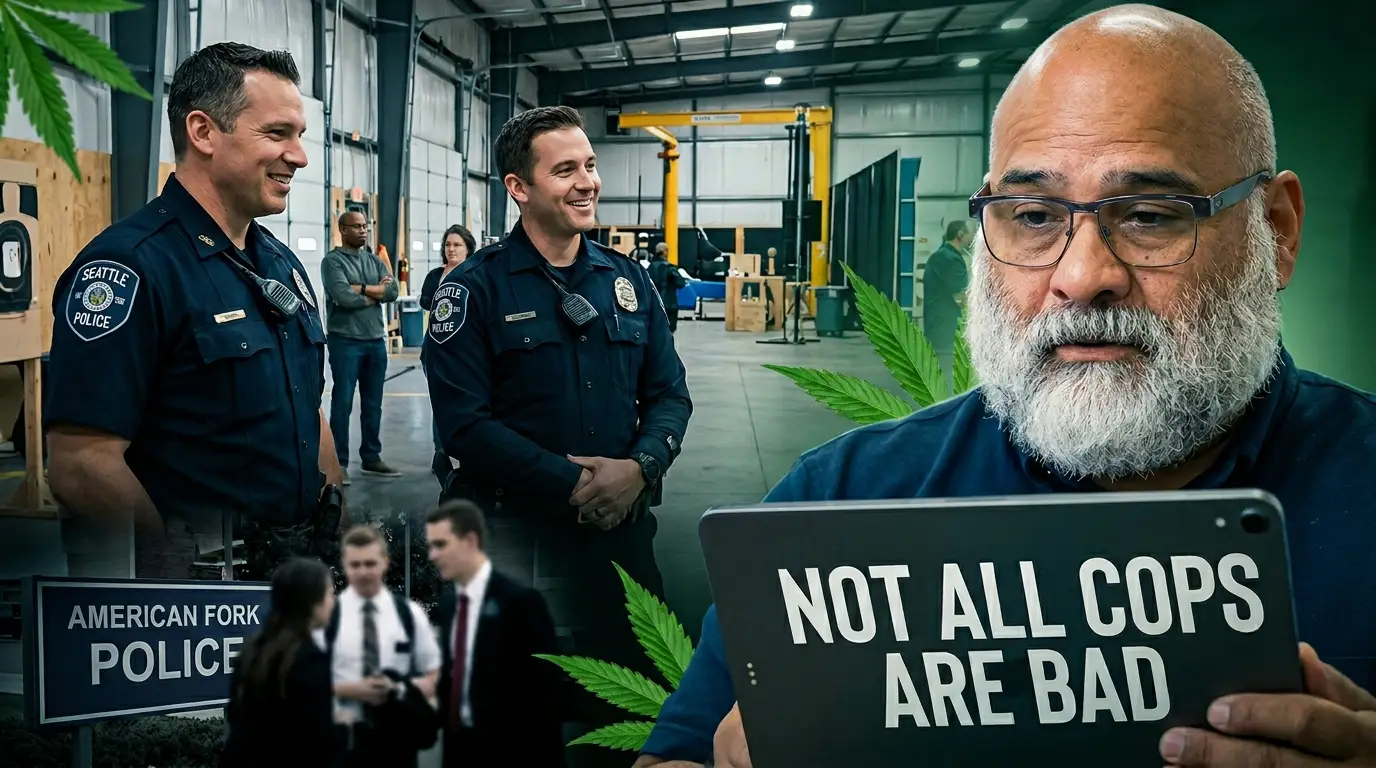
Not all cops are bad—except the American Fork Police Department, which seems run by a strict Mormon hierarchy. Most cops are just people. Someone’s son, daughter, husband, wife, or throuple; just another human being trying their best. Human, or at least the ones I met at Seattle’s Green Lab were.
Everything law enforcement does should be for the greater good: justice by the numbers, mixed with a dash of anecdotal evidence of the things people have actually done. Good cops don’t want to ruin lives; they want to protect them. That’s exactly what this Green Lab in Seattle was about.
Ignorance and division are the direct results of prohibition—the thin line between the average citizen and protection. I don’t hide my alcohol use, so why should I hide my weed? How many accidents has cannabis actually caused where the driver was truly stoned out of their gorge when police arrived?
But also, what does it even mean to be “stoned”?
Unlike beer cans falling out when a car door opens, there’s no obvious, immediate indication of cannabis “intoxication.” Finding dab rigs and pipes at a scene shouldn’t inherently lead to an officer automatically assuming a person’s impairment, nor should it be entirely ruled out. The real question is: what does it mean to be “high” or “stoned”? What does cannabis intoxication and driving actually mean? How many cannabis DUI-highs have been issued, and what really happened?
I ask this not just for society, but for my own peace of mind as an advocate. What exactly have I been cheering on and fighting for all these years?
As I got ready to smoke cannabis right in front of the Seattle Police Department and then some—for science!—it almost felt like crossing a line. It felt like betraying my fellow stoners. But there’s a necessary evil and a vital question here: how can a police officer actually tell when someone is genuinely under the influence of weed?
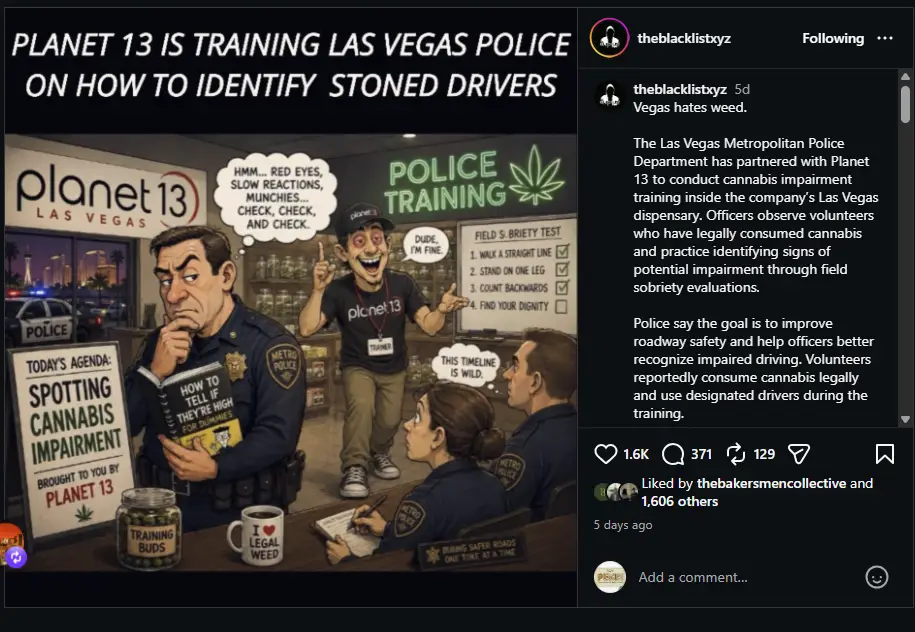
Change is inevitable. You’re either part of the conversation, or you shut the fuck up.
Establishing the Baseline
We started in a classroom. As the volunteers entered, the smells became louder and louder, and voices filled the room as everyone established their initial baseline. One volunteer brought a crystal bong resting on a lazy Susan with all her accoutrements. Another brought a preroll, a vape, and a blunt to roll, just in case. There was a gentleman who looked right about my age (fuck, I’m old) who brought two cannabis shots meant to be mixed into a larger drink. Then there were the casual vape-only users, and the flower people like me.
First, a baseline was taken, and here’s where things get tricky. My pulse was about 66, my eye dilation was completely normal, and my consumption was zero for the 24 hours prior. The only weed in my system was resting in my fat ass.
Next came the eye tests. You know the ones: follow my finger until I say stop.
Officer Luke, who was both an officer and a gentleman, established my baseline and was surprised by my eye indications. I have a natural nystagmus—an eye tracking anomaly—that cops often mistake as an indication of antidepressants or intoxication. This is where things get scary.
The exact same issue was noted in a recent Reckless Ben video, where the American Fork Police Department harassed a YouTuber over false accusations mixed with a dash of Mormon Church corruption. In the video of Ben being pulled over, we see the cops pointing to a completely natural eye tracking anomaly in the driver as definitive “proof” of intoxication. This is scary as fuck when you realize these tests could flag up to 80% of the population as a false positive.
Another weird thing my eyes don’t do—which cops use as a key cannabis indicator for intoxication—is flutter when I lean my head back and close my eyes. As my law enforcement liaison would say, I have “funny eyes.” I’m an anomaly, a professional stoner. But I like to think of myself as more of an average citizen—someone who wakes up and simply tries to be the best human they can be. Cannabis is one of the things the law has yet to get right. Prohibition has consistently done far more harm than good for society.
After establishing our baselines, we moved into a bigger classroom where we sat in groups with various Washington State law enforcement: the Sheriff’s Department, State Troopers, local PD, and even a few officers from out of state. We were assigned to work with a specific group of three.
The group I started with consisted of one Sheriff, a State Patrol officer, and a local PD officer from the east side of the state. They all asked genuine, curious questions about my consumption, like, “How do you choose your weed?” and “Do you consume and drive?”
I answered honestly, to a point: “Yes, I do smoke and drive, but I caught the bus today.”
I panned the room of smoking consumers and cops—all human, all part of my statewide community. My America. Some were social, some were quiet, but both sides were just people. There were no gotcha moments here, no one trying to trick me into failing a test that could alter the entire trajectory of my life. Depending on your employment situation, a failed test means you could very well have to find a new job, not to mention the legal proceedings, lost time, and money drained out of your life.
Like I said, there were no gotcha moments. In fact, I was never identified as intoxicated. Maybe I’m just an outlier. I’ve been advocating for cannabis reform since before I could legally drive, and I’ve always treated this plant with common sense. Common sense should be applied to all things in life. I would be scared to be in a room with a lion, but a room full of kittens? Throw me right in.
Speed Smoking for Science
Before the physical tests could begin, we had to smoke.
I lose thousands of dollars worth of cannabis in a series of small fires throughout the day. I smoke a lot of weed. In fact, I’ve been “high” for nearly 15 years, ever since Washington State only had medical cannabis laws. There are many people out there like me who have an abnormal relationship with this plant, but I see it as no different than the relationship people have with their morning coffee or evening alcohol. In the end, legalization is entirely about personal choices and knowing yourself.
Thirteen of us potheads headed out to the tents set up outside. Under the tents were tables, chairs, and plenty of refreshments in case the cottonmouth got to be too much. I settled into the corner with my eighth of Chocolatina by Skord and smoked my little heart out until it was time for the next portion.
And this is probably where I’m unique: the “been there, done that” of cannabis consumption. As I sat there, smoking like I was a kid with Christmas weed, I was hit with major Seattle Hempfest vibes and memories of old-school cannabis events. During peak prohibition, those underground events brought a massive sense of community. The weed was abundant and smoking was highly encouraged, all while we were breaking the exact same bad law with the exact same chance of going to jail if the place got raided.
Out under the tents, the vibes between law enforcement and consumers were great. They genuinely just wanted to see what real “under the influence” looked like. There was zero judgment—just open conversation.
My daily consumption at home is usually just two to three puffs on a pipe before moving on to whatever I’m doing. In the morning, it’s a couple of puffs and off to work; during the evening, many more puffs, usually while playing Call of Duty or writing. For this experiment, though, I tried my absolute best to get completely fucked up. I honestly wanted them to point out exactly where and how I was screwing up, if I was at all.
So I smoked and I smoked, while my initial group of officers sat with me and asked more questions. Honestly, I think they were catching a contact high. The whole thing was a vibe.
After we achieved enlightenment, we were guided into a massive warehouse that had been staged for us to perform standard field sobriety tests. Smoking in front of cops with clipboards is one thing, but walking into a warehouse filled with parked SWAT vans and Command Network vehicles was entirely surreal.
30 Seconds to Mars: The Core and Balance Test
We got to our spot and were given instructions. It was like speed dating, but for physical assessments: start with one police group, do the tests, and rotate to the next.
Walking in, I was super high. If I hadn’t been participating in a study, I would’ve opted for a nap or lying in the sun like a lazy cat. Instead, I was answering questions about whether I had any medical conditions that could skew my physical results. I do, in fact, have a bad knee and a bad shoulder.
The first group set the stage for the rest of the day. There are no surprises here—if you’ve ever watched an episode of COPS, you know exactly what you’re in for:
- The Walk and Turn: Walk a straight line, heel-to-toe, nine steps, count them out loud, turn around precisely, and walk nine steps back.
- The Horizontal Gaze Nystagmus: Follow my finger with your eyes only, don’t move your head.
- The One-Leg Stand: Hold one foot parallel above the ground, about the height of a soda can, and count out loud (one-thousand-and-one, one-thousand-and-two…) until told to stop.
- The Finger-to-Nose: Hold your hands out, tilt your head back, close your eyes, and listen for the instruction of which specific finger to touch to the tip of your nose.
- The Lack of Convergence: Close your eyes, tilt your head back, while they look for an eye flutter (something mine refused to do).
- The Internal Clock: Close your eyes, tilt your head back, and give your absolute best guess of when 30 seconds have passed. Once you hit the number, tilt your head forward and say stop.
A lot can happen in 30 seconds. I always wondered about field sobriety tests—like how far a person actually has to walk before a cop feels comfortable letting them get back behind the wheel, or how long you have to hold your foot up to be legally considered “sober.” The official answer is nine steps and 30 seconds.
Field sobriety checks are nothing new, so what I’m explaining isn’t a state secret. We all generally know what they look like, but would you actually pass one completely sober? Most people never think about it because they plan on being responsible, assuming they’ll never give an officer a reason to pull them over. But sometimes we think entirely too highly of our basic physical capabilities.
Maybe I am just an extraordinary stoner, or maybe my physical therapy for the past two months accidentally trained me to ace this exact experiment. As I said, I have a busted knee and a bad shoulder. For the last two months, my physical therapist has had me doing strict 30-second stability exercises—not sets and reps. Trust me, 30 seconds of pure balancing can absolutely kick your ass, no matter how healthy you are. The absolute biggest factors in passing these tests are core strength and physical balance. Because I had spent the last two months training those exact muscle groups, the physical tests felt remarkably good.
Running through multiple 30-second segments doing different physical tricks is a solid way for an officer to judge someone’s demeanor and balance, but sometimes everyday citizens naturally have neither. If I hadn’t been actively doing physical therapy, I feel I easily would have failed simply due to a weak core.
But sobriety shouldn’t be entirely subjective.
If you drink alcohol, there is almost always a distinct point where you tell yourself, “I cannot possibly drive right now,” and you still feel that exact same impairment an hour later. It is not the same with cannabis. Walking into that warehouse, my high was at an 11 out of 10. But by the end of my very first testing group, it had already dropped down to a 6. I felt good, and I wouldn’t have been sad if there was no more weed left to smoke.
This isn’t to say cannabis doesn’t cause impairment. Like many other poor life choices, you usually realize it entirely after the fact. There have certainly been times in my past where I heavily questioned my own judgment for consuming right before driving or heading into work—not because I started seeing things or had weird urges, but simply because I became incredibly tired and didn’t want to deal with the everyday bullshit of my day.
There are many ways to understand this plant. You can learn through personal consumption and developing a deep relationship with your own body, or you can learn like these cops did. They don’t consume, but they took the time to learn and understand complex concepts like decarboxylation, the entourage effect, and the endocannabinoid system (seriously, thank you for caring, Officer Luke). These are the cops who want to arrest the actual bad guys for the right reasons. They aren’t looking to bust a pothead camping in the woods and smoking quietly with friends; they are looking for the person going 120 MPH through a residential neighborhood. In the end, it always comes down to personal responsibility. The weed didn’t make you do it.
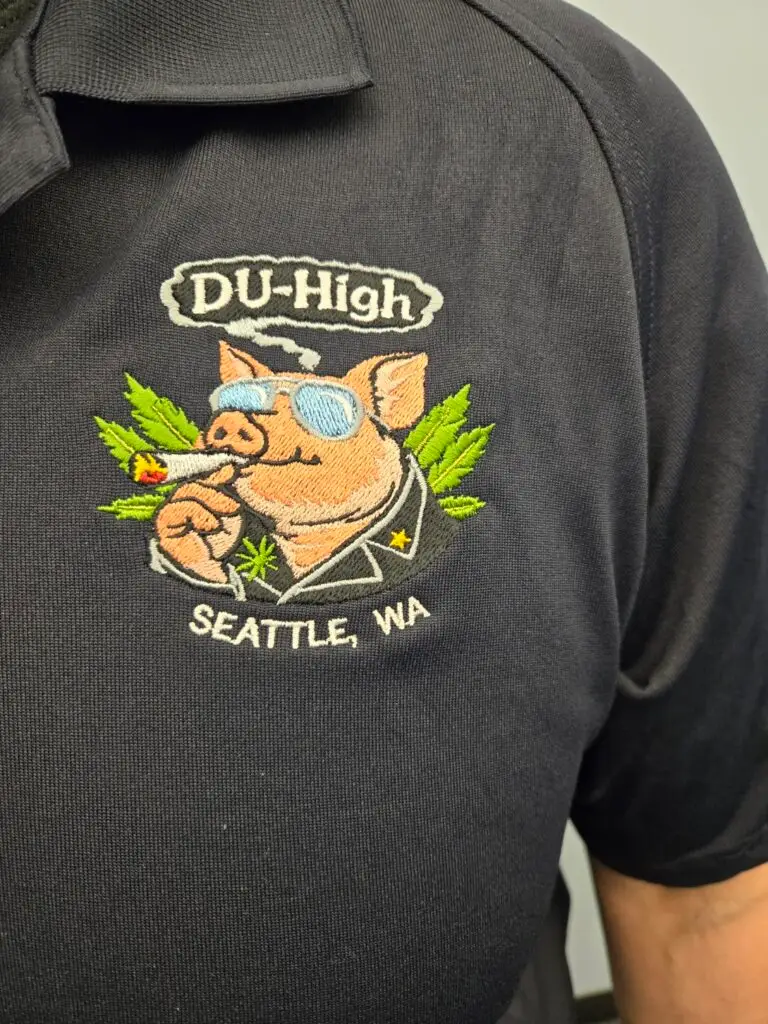
Smoke and a Pancake
The Seattle Police Department were incredibly gracious hosts. Prior to showing up, the coordinators asked us what kind of snacks we wanted. I jokingly asked for pinwheels, and they actually came through with them.
From the testing warehouse, we were funneled back into the classroom to meet up with our assigned officer buddy groups. They provided the snacks, pizza, and refreshments. We sat down together, and the officers continued to probe. Nothing felt invasive—just standard pulse checks, eye follows, and asking on a scale of 1 to 10 how we felt. By then, I was sitting at a comfortable 2 or 3.
We ate, talked, and then it was right back off to round two.
Once again, I puffed my little heart out in the tents. I really tried, coach. Some of the officers chose to sit right outside the tent doors on the second round; I’m pretty sure a few of them were catching a serious contact high. It was fascinating to watch: a group of cannabis consumers actively trying to get as fucked up as humanly possible while a ring of law enforcement watched intently.
It was nice seeing the cops so purposefully engaged. One female officer told me her mother had been a cannabis patient her entire life, so she grew up completely surrounded by weed, she just didn’t happen to partake herself. The cops would ask questions or just observe our behavior in general. When one consumer who brought multiple devices finally switched over to her heavy glass bong, I watched a State Trooper immediately make a detailed note on his clipboard. It gave off pure Jane Goodall vibes, and we were the apes in the habitat.
After the allotted smoking time, we were herded right back into the warehouse.
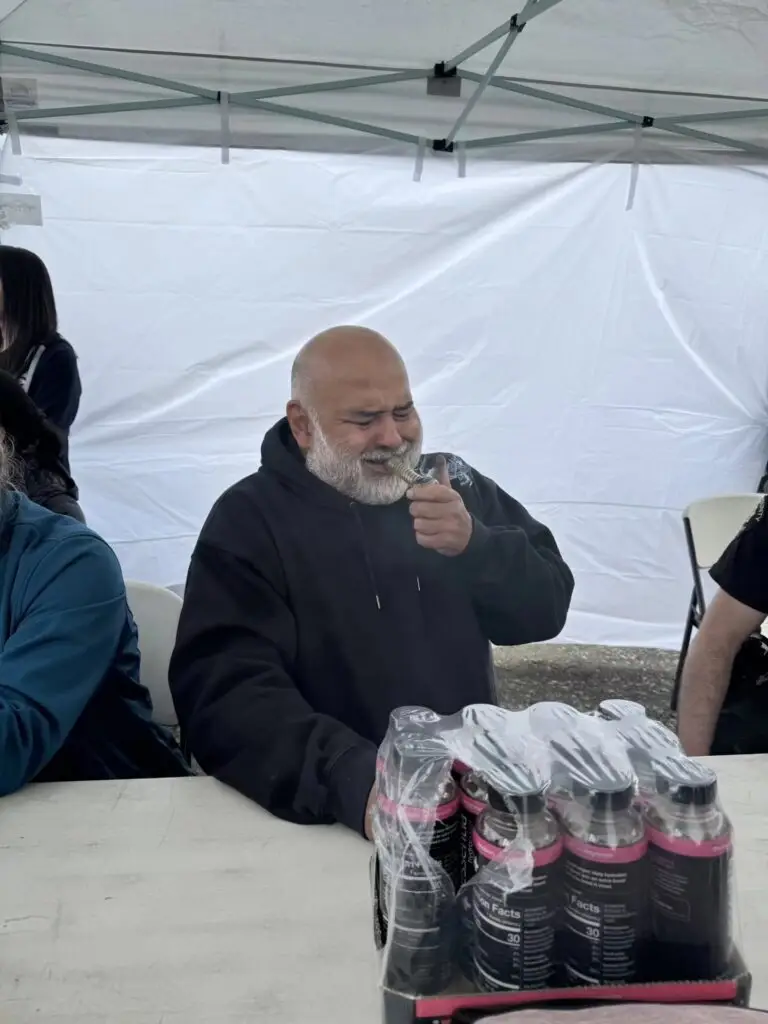
Two Sessions, One High
Performing in the Smoking Olympics is definitely not my normal routine, but I’ve certainly been this high before. At every major protestival—Seattle Hempfest, the Marijuana March, and random medical marijuana advocacy gatherings over the years—I’ve seen it all, and I’ve even greened out once or twice. This was nothing new, just a highly unusual setting.
If you’ve ever been too drunk, you know it feels miserable. Being too high doesn’t kill you; it just occasionally makes you feel like you’re going to die.
Again, I started round two at an 11 out of 10, but by the end of the second speed-dating rotation of sobriety tests, I was already back down to a 4. In my own mind, I felt completely fine and likely sober enough to drive if I absolutely had to. The most familiar feeling I get from massive over-consumption is simply the overwhelming urge to lie down and rest.
By the midway point of the second round of field sobriety tests, the process genuinely became work. Unlike alcohol, there is nothing inherently special about smoking weed that completely destroys your ability to count or maintain your physical balance. Your thought processes and reaction times do slow down, but are they universally significant? I think it will always come down to the specific person and the specific situation.
Crash and Burn: 30 Years of Road Warrior Anecdotes
The officers at the Green Lab are looking for a magic, objective metric to predict who crashes and burns. I didn’t have the final data for them, but looking back at my own 30 years on the road and in the movement, I had plenty of my own anecdotes.
No one wakes up and thinks, “Today is the day I want to ruin my life and someone else’s.” But that happens every single day. Substance abuse isn’t the only cause of traffic tragedy. There’s distracted driving with cell phones, dropping a lighter on the floorboards, blinding sun glare—so many things cause accidents. If we can prevent them, I absolutely believe we should.
But how? Personally, I’m of the mindset that if I’m screwing up, I want to know. If my consumption ever put me on the brink of hurting others, I would want someone to tell me. Please, for the love of God, pull me over if you ever see me drifting into the wrong lane for any reason whatsoever.
That has never been the case for me, but the same couldn’t quite be said for all the volunteers at the lab. Some completely lost their physical composure during the tests, which is fine for an experiment, but could they actually drive safely? Did they feel like they could drive?
What does the data and allegorical evidence tell you? This is exactly what I was left wondering. So, I reached out directly to the coordinators of the event. As of right now, the final official report is still being compiled regarding the collected DUI-high arrest data. I heavily wonder if there will be any real info on what specifically led to the initial traffic stops in those cases, but most likely not.
However, I did walk away with two incredibly telling stories told to me directly by the officers at the lab:
- The Day-Dabber: One officer told me about a single-vehicle accident where a driver slammed directly into a tree. The driver openly admitted to the responding officers that he was an “all-day dabber.” Was the wax the definitive cause of the accident? Who’s to say, except the law enforcement officer writing the report at the scene.
- The Middle-of-the-Road Parker: The second story is incredibly believable simply because entitled, stupid people exist everywhere. A driver decided that the literal middle of a main road was the perfect spot to park their car and hang out. No one was harmed, it was just an incredibly terrible decision.
Southern California, 1990s: “Just Weed, Officer”
To this day, I still don’t know if it was the weed or just a moment of pure carelessness, but I hit someone once.
It was early evening, and I was pulling out of an AM/PM parking lot after a long day of setting up corporate parties. Back then, during peak prohibition, I would smoke the devil’s lettuce immediately after work in my car—but only ever while it was in park. In the work parking lot, in the AM/PM lot, pretty much anywhere I could remain completely still so I could keep a sharp eye out for the police.
The exit of this particular lot was on a steep hill, and that’s where I misjudged things. I tried exiting on the side hill, panicked, and sideswiped an oncoming vehicle. Luckily, I just left a dent, but it was enough to scare the hell out of all of us. No one wants to be the cause of someone else’s bad day. On that day, I was.
I hit the side of the vehicle and vividly remember making direct eye contact with the passengers inside, because the car was completely full. It is an awful feeling to make eye contact with a family you just hit.
The driver pulled over immediately, and so did I. My instinctive thought at the time was to avoid the police and avoid the system at all costs. I apologized profusely and struck an immediate street deal. For instant payment and compensation, I ran and got the driver a quarter-pound of weed. We shook hands, and the law never got involved.
The next story isn’t nearly as bad, and it proves that good cops frequently worry about actual bad people, not just a couple of potheads cruising around.
It was the week of my brother’s birthday on a warm, Southern California October day. We were cruising the Oceanside strand—a mile and a half of road running directly alongside the ocean where the waves will literally splash your car on a windy day. At the end of the strand, you’re greeted by a series of stoplights as you transition back to the main highway. At the time, a left turn was strictly illegal at that particular light, but guess what my high ass didn’t know?
I made the illegal left and a cop car flipped its lights on instantly. I made the next quick right to safely park. When I rolled the windows down, a massive wall of thick smoke billowed out of the car. We had been hotboxing our little hearts out. It looked like a literal scene out of Cheech and Chong.
If there is one piece of absolute advice I can give you regarding weed and law enforcement, it’s this: if it is completely obvious, do not lie. Lying is only going to dig you into a much deeper hole.
While I was pulling over, my brother quickly stashed our main baggie in his pants, and I shoved the hot pipe directly under my butt. The officer approached the window, looked at the smoke, and asked if we had any drugs in the car.
I looked right at him and replied, “Just weed, officer.”
At the time in Oceanside, methamphetamine was the single biggest threat to the community (now, like the rest of America, it’s fentanyl and a broken healthcare system, but that’s an entirely different article). Hearing my honesty, the officer sighed and asked, “No, are you guys doing anything else? Any alcohol, any meth?”
Because we had family members at the time struggling heavily with severe meth habits, we avoided hard drugs like the plague. We all instantly responded, “Hell no!” and immediately started venting to the cop about our personal family issues with hard drugs. The officer realized we were telling the truth, relaxed, and asked, “Alright, where is the weed?”
I had my brother hand over the baggie and told the cop it was all mine. He asked how we were smoking it, and I pulled the pipe out from under my seat and handed it over.
The officer had me step out of the car and walk about three yards in front of the bumper. He handed me our bag of weed and told me to dump it out on the dirt, which I quickly did. Then he handed me back my empty glass pipe, looked me in the eye, and told me to stop smoking while driving and get our asses straight home. We did exactly that.
The Misdemeanor Jenco Jeans Era
My next interaction did not go nearly as smoothly, and it’s the exact reason I had to get a special legal waiver just to enlist in the Navy, costing me my shot at an advanced military computer electronics school.
It was early in the morning, and I was driving to my construction job. It turned out I had a burned-out brake light. This time, I wasn’t acting like Bob Marley—I’m not against a morning bowl, but I hadn’t smoked a single thing that day.
The officer pulled me over and immediately asked if I had drugs in the car. Me being me, I replied honestly: “Just a little marijuana, officer.” Keep in mind, I had less than an eighth (3.5 grams) on me.
Despite being completely honest and handing it right over, the cop’s tone shifted instantly. Within minutes, I was handcuffed in the back of a police cruiser while three additional backup cars rolled up and began absolutely tearing my vehicle apart.
I think because of how I dressed, the cops automatically assumed I was a gang banger. In reality, I was just a brown kid who liked wearing wide-leg Jenco jeans and plain white shirts. As they ripped through my car, I became incredibly upset and boisterous.
“What the hell are you doing?!” I yelled from the back seat. “I was completely honest with you! Why are you doing this?!”
The officer turned around and snapped, “Shut the fuck up, or we can finish this conversation from a jail cell.”
After an hour of searching and finding absolutely nothing else, they handed me back a completely disheveled, ruined vehicle. I was incredibly late for work and walked away with a misdemeanor ticket—because at the time, possessing under an ounce of cannabis was still a criminal offense. They were praying for a felony, but had to settle for a fine.
Fast forward thirteen years. I was out of the military and working as an electronics technician out of Seattle, Washington, where I had the absolute honor of volunteering at the legendary protestival known as Seattle Hempfest.
One morning, after walking up and down the 1.5-mile stretch of land helping out vendors, I lit up a morning bowl while walking down the park path. A cop on a bicycle rolled right up next to me. Out of pure reflex, I instantly tried to hide the pipe behind my back. The cop just looked at me, smiled, and said, “Good morning! Just like a morning cup of coffee, huh?” and kept right on riding past.
Detained in Interstate 80 High-Tolerance Limbo
The final story is the exact reason why I am now the co-owner of a legal cannabis dispensary.
Not all rules surrounding “legalization” make any sense. For instance, in many states, if you were caught with cannabis in your past, you are completely disqualified from entering the industry. Like, what? But I was caught with just enough, and it changed everything.
I was working in the third-party calibration industry, servicing the Pacific Northwest and beyond. My long-haul road trips would have me starting on the east side of Washington State, then driving through Idaho, Montana, Wyoming, Oregon, and occasionally South Dakota. It was in Wyoming where my violation occurred—a state where cannabis is still treated as a strict felony.
Back then, I was a certified road warrior. Driving a tech van for 10 to 12 hours a day was vastly better than deploying overseas in the Navy where I couldn’t talk to my family, but I was still isolated. My smoking habits by this point consisted of getting on the highway and taking the occasional small puff from a pipe while driving the long desert stretches.
On this particular morning, I remember passing an impromptu police checkpoint being set up along Interstate 80. I had one of those “whew, dodged a bullet” moments. But I hadn’t.
By this point in my life, I operated with absolute best practices: I always kept a sharp lookout for surprise trooper cars hiding over hill crests, and I meticulously made sure every single light on my vehicle was fully operational. I never gave them a legal reason to pull me over. But sometimes, simply being a dark-skinned guy driving a vehicle with out-of-state plates is treated as probable cause.
I had just left Laramie, Wyoming, on my way to Rock Springs. Most of Interstate 80’s speed limit is 80 MPH, so my favorite tool for long stretches of highway was cruise control. About 15 minutes after passing that checkpoint, a state trooper SUV appeared directly behind me. No big deal, I thought. I have my cruise control locked in.
The trooper followed me closely for a few miles, sped up to drive directly side-by-side with me while staring into my windows, and then slowed back down to get right behind my bumper. This is when I knew I was in deep trouble. It was 8:00 AM, and there were absolutely no other cars on the road except me and him.
The blue lights flashed, and I pulled over. I forgot to mention that I was driving a corporate company vehicle at the time. When the trooper ran the plates, it tracked straight back to a Fortune 500 company, not an individual.
The officer approached the passenger side, so I rolled that window completely down before he arrived. He leaned his head in and went through the standard line of questioning while looking over my face and scanning the interior. I hadn’t smoked anytime recently, so there was no burnt odor, but my center dashboard console had a few loose crumbs that I hadn’t cleaned up.
Spotting the green specks, the trooper pointed and asked, “What is that?”
Once again, I couldn’t help but be honest. “Weed,” I said.
Now, there is a fine line between being honest and being too honest. He asked if I had been smoking it right then, and I replied, “Oh, no, officer, that’s just leftover from yesterday.”
Within minutes, I found myself handcuffed and detained in the back of his police SUV while he began tearing through my corporate van. This time, no backup was called; it was just me and him out in the middle of the Wyoming desert. I was scared shitless—for my freedom, my career, and my overall safety.
The trooper claimed he pulled me over because my speed was “fluctuating.” I informed him that the car was locked on strict cruise control, but he completely brushed it off.
As a traveling metrologist, my van was loaded with thousands of dollars of sensitive corporate testing equipment used to measure RF, DC, temperature, torque, weights, and scales. In the center console rested my very first grinder—completely packed with a massive layer of kief—and my luggage was packed with cannabis culture magazines, some of which I had actually contributed to. Because of the magazines, the trooper drilled me, asking if I was an underground grower. He even tried the classic cop line: “You can be completely honest with me, man.” I told him I was simply a dude who loves pot.
After the interrogation, he finally let me out of the handcuffs and back out of the SUV. He drilled me a little further about how if I come to work in Wyoming I technically need some specialized out-of-state transport permit, but he ultimately handed me a citation, making me promise to settle it with the local courts—which is a whole other story about a completely broken legal system.
He let me go. I was in such a state of pure panic and relief that I actually thanked him, shook his hand, and continued my long-ass drive with a completely disheveled vehicle and absolutely no weed left.
The Takeaway: Normalization vs. Criminalization
The fact that corporate drug testing companies are currently spending millions fighting the federal rescheduling of cannabis means one thing: true legalization is finally coming. But for that to successfully happen, we have to let the world know that everything is going to be okay.
California’s Prop 215 in 1996, even though it wasn’t the absolute first, was the foundational law that stuck. It gave millions of patients the chance to find medicine and allowed people to finally build a legitimate business around a plant so many of us hold dear. California made patients no longer criminals, but they initially left the people trying to conduct the actual business of supplying it completely hanging.
Washington State and Colorado were the first two states in 2012 to allow for an adult-use market while attempting to maintain a steady supply for medical patients. It has been decades since those first laws established an adult-use market, and guess what? The states aren’t ruined. America is not worse off. In fact, it’s a little bit better. Citizens finally have a few more fundamental rights than they did before.
True legalization is not about fighting for the right to smoke and drive blindly down the highway. It’s about fighting for the right to smoke on your own time and not lose your job, your career, or your constitutional rights over a personal choice. It’s about not being judged for what you do in your personal life when you are doing absolutely no harm to others.
The streets are ultimately neither worse nor better off due to legalization, because traffic safety will always come down to personal responsibility. What the exact national numbers say about cannabis DUIs, I don’t fully know yet—but as soon as the Green Lab report is finalized, you’ll be the very first to know.
Cannabis normalization is coming. What this experience showed me is that Washington State law enforcement is finally getting well-acquainted with the idea that a lot of productive, responsible people they encounter on a day-to-day basis are, for lack of a better word, under the influence.
Not all cops are bad—except for the American Fork Police Department (seriously, look up the Mormons and the Legos case). The ones I interacted with during the Green Lab made me feel like it’s finally safe to just be who I am.
As long as I don’t fuck up. So, the moral of the story? Know your limits, know your rights, and don’t fuck up.
Evidence
Reporting and primary sources
We have not added a separate source list yet. Use the links in the article above while we finish organizing it.